Tuesday, January 9, 2007
FAT AS A SOCIAL CLASS MARKER
A line from the comedy troupe the Doug Anthony All Stars has long stayed with me: "People are poor and ugly because they choose to be poor and ugly." Its cruelty got a few laughs but for some reason it struck me as a particularly nasty view of the world. Throw the word "fat" in with poor and ugly, and this mockery of an underclass has launched a legion of reality TV shows. In You Are What You Eat, shame is part of the game. Not only is the particpants' weekly diet of junk spread out on a buffet like a gooey, sick-making reproach but their faeces are examined and ridiculed by a prim and thin host. In Britain these shows are plentiful, cheap to make and have no shortage of "talent".
In Honey I Killed the Kids, parents are put in the metaphorical stocks for feeding their children junk food and are shown a computer simulation of how those children will age if they are kept on a diet of processed food. The parents gasp and reel with horror as their little Augustus Gloops morph into grotesque, mean-looking chavs, old before their time because they are rotting from the inside out from all those additives.
In Too Fat To Walk, the camera angles are reminiscent of a cheap porn film, but instead of stimulating our desire, these shows are designed to provoke our disgust. There are startling and lingering close-ups of cellulite, stomach rolls, chafed inner thighs and, of course, tears. Contestants are not only exhausted from walking up mountains but are filled with self-loathing and disgust. This show is their hairshirt - a humiliation or atonement for lacking self-discipline. As for the viewers, the only reaction can be disgust. These shows make us feel smug and self-congratulatory about our lifestyles. It relieves us, for the briefest time, of the relentless pressure to conform to the unrealistic images that flood us from more aspirational lifestyle shows.
But these shows carry other odious undertones - they encourage us to sneer at poverty. As well as being fat, most of the contestants on these shows are white, poor and working-class. They are torchbearers of an emerging new class system based on nutrition. Before the hysteria over the obesity epidemic there were other indicators that measured class such as accent, education and profession.
Now such elitist snap judgments can be made by observing what goes into your gob or shopping trolley. A survey released in Britain yesterday found the fatter you were, the less you earned, with lower-paid clerical workers nine times more likely to be overweight (75 per cent) than those at upper-management level (8 per cent).
Lack of money can lead to poor diet since the fat underclass work night shift, or double shifts in low-wage jobs, or they don't work at all. They buy frozen or takeaway food, they do not know how to cook and their children are fussy eaters. They line up under the fluorescent lights of McDonald's unable to resist the offer of an upsize. They buy the wrong cuts of meat in the supermarket and they load trolleys with processed food such as chips and frozen pizzas that not only contain an environmentally unsound surplus of packaging, but enough additives to give their children attention deficit disorder.
The middle classes, meanwhile, have developed an almost religious fervour around exercise and nutrition, none of which comes cheap. Look in their shopping trolley: artisan bread ($10) that weighs a tonne, soups in cartons from chilled shelves instead of in tins on shelves, anything labelled "organic" or "free range", freshly squeezed juices and anything marketed as fresh, from pasta to seafood to sauces. It costs a lot to follow this lifestyle.
In a recent article in The Spectator magazine Allister Heath explored the link between fast food and crime and between the haves and have-nots. He observed that a section of society raised on violence and fast food is drifting away from the rest of Britain. Nutrition has become destiny. "Of all the shootings of the past few days, those in the Brixton McDonald's were the most dramatic because they highlighted the divergence between the values and habits of the modern, health-obsessed, metropolitan middle-classes and those of the underclass," he wrote. "The two groups now live in completely different worlds."
But the piece contained a warning for the middle classes, so in the thrall of healthy, organic produce, so willing to squeal with disgust at the fatties on TV. If we say "let them eat cake", we are condemning a generation not only to chronic health problems but also to an inequality which is measured not just by where you live, but also by what you eat.
Source
HEREDITY FACTORS IN BODY WEIGHT REAR THEIR HEADS
Though not admitted as such
Girls as young as nine show an increased risk of heart disease as a result of being overweight. Higher blood pressure and unhealthy changes in cholesterol and triglycerides in the bloodstream suggest that the long-term consequences of puppy fat could be serious. They also show that the years between 9 and 12 are a crucial period for becoming overweight and that once the weight is on it is hard to shift.
Girls who were overweight at the age of 9 were nearly 15 times more likely to be overweight as young adults than those who were of normal weight at 9, a study shows. The authors, from the US National Heart, Lung, and Blood Institute, give warning that childhood obesity may have serious short and long-term consequences. "Girls who were overweight were three to ten times more likely to be assessed in the risk range on four out of six health indicators, and had three times greater odds of having elevated levels of LDL cholesterol," the team concludes in The Journal of Pediatrics.
More than 2,300 girls aged 9 or 10 were enrolled in the study and followed for more than ten years. The team measured their height, weight, blood pressure and cholesterol every year until they were 18 and had extra measurements made when they were 21 to 23. The study also compared white girls with those of African-American origin. It found that black girls were 1.5 times more likely to become overweight at any given age than white girls. Being overweight was also about twice as common in black girls between the ages of 9 and 18 (17-24 per cent).
A second study has shown that men who are overweight or obese are significantly more likely to die of prostate cancer. Obesity is known to increase the risks of a range of cancers, including breast [False!] and bowel cancer, but this latest study produced a puzzling result. The risks of dying from prostate cancer may be increased by being obese, but the risks of getting it are actually decreased. [Hooray for fat!]
A team led by Margaret Wright of the National Cancer Institute in Bethesda, Maryland, followed 287,760 men aged between 50 and 71 as part of a diet and health study. It reports in Cancer that there is a clear link between weight and death from prostate cancer. Men who were severely obese had a doubled risk. But neither overweight nor obesity increased the risk of getting the disease. The authors explain this by suggesting that overweight and obese men have lower testosterone levels.
Source
****************
Just some problems with the "Obesity" war:
1). It tries to impose behavior change on everybody -- when most of those targeted are not obese and hence have no reason to change their behaviour. It is a form of punishing the innocent and the guilty alike. (It is also typical of Leftist thinking: Scorning the individual and capable of dealing with large groups only).
2). The longevity research all leads to the conclusion that it is people of MIDDLING weight who live longest -- not slim people. So the "epidemic" of obesity is in fact largely an "epidemic" of living longer.
3). It is total calorie intake that makes you fat -- not where you get your calories. Policies that attack only the source of the calories (e.g. "junk food") without addressing total calorie intake are hence pissing into the wind. People involuntarily deprived of their preferred calorie intake from one source are highly likely to seek and find their calories elsewhere.
4). So-called junk food is perfectly nutritious. A big Mac meal comprises meat, bread, salad and potatoes -- which is a mainstream Western diet. If that is bad then we are all in big trouble.
5). Food warriors demonize salt and fat. But we need a daily salt intake to counter salt-loss through perspiration and the research shows that people on salt-restricted diets die SOONER. And Eskimos eat huge amounts of fat with no apparent ill-effects. And the average home-cooked roast dinner has LOTS of fat. Will we ban roast dinners?
6). The foods restricted are often no more calorific than those permitted -- such as milk and fruit-juice drinks.
7). Tendency to weight is mostly genetic and is therefore not readily susceptible to voluntary behaviour change.
8). And when are we going to ban cheese? Cheese is a concentrated calorie bomb and has lots of that wicked animal fat in it too. Wouldn't we all be better off without it? And what about butter? It is just about pure fat. Surely it should be treated as contraband in kids' lunchboxes! [/sarcasm].
Trans fats:
For one summary of the weak science behind the "trans-fat" hysteria, see here. Trans fats have only a temporary effect on blood chemistry and the evidence of lasting harm from them is dubious. By taking extreme groups in trans fats intake, some weak association with coronary heart disease has at times been shown in some sub-populations but extreme group studies are inherently at risk of confounding with other factors and are intrinsically of little interest to the average person.
The use of extreme quintiles (fifths) to examine effects is in fact so common as to be almost universal but suggests to the experienced observer that the differences between the mean scores of the experimental and control groups were not statistically significant -- thus making the article concerned little more than an exercise in deception
*********************

Monday, January 8, 2007
Low-carb diets may hit levels of folate
Once again slimming is bad for you
A disturbing drop in the blood folate levels in young American women, which could lead to increased birth defects, may be a result of the growing popularity of low-carb diets. Government health officials said yesterday that, while it was unclear what had caused the slide in the important B vitamin, diet trends could well be a factor.
A Centre for Disease Control and Prevention study released yesterday found an 8 to 16 per cent decline in folate levels in US women of childbearing age, according to large blood-drawing surveys done between 1999 and 2004. It is not clear how the decline has affected newborns, but preliminary data suggest the dramatic declines in neural tube defects seen in the late 1990s may have levelled off by 2004, CDC officials said. "This is a cause of substantial concern," said Nancy Green, medical director for the March of Dimes, which campaigns for birth defects prevention.
It is the first time such a decline has been seen since the start of government health campaigns urging women to make sure they get enough folic acid. Years ago, scientists concluded that folate deficiencies contributed to the occurrence of serious birth defects of the spine and brain, known as neural tube defects. The Government has long urged women to eat cereals and breads fortified with folic acid to prevent birth defects. By the late 1990s, the fortification campaigns were succeeding: folate levels increased, and neural tube defects dropped by as many as 1000 a year.
CDC epidemiologist and lead author of the study Joseph Mulinare said that in 1998, the Food and Drug Administration began requiring that folic acid be added to breads, cereals and other products that use enriched flour. Whole-grain breads did not count because they already contain some folate.
Low-carb diets have increased in popularity since 2000. Women who avoided flour and bread products for their carbohydrates may have also taken in less folic acid, Mulinare said.
Increasing obesity rates among young women could also be a factor. Research has found obese people metabolise folate differently from thinner folk, and some doctors believe heavier women need more folic acid to prevent neural tube defects.
The decline was most pronounced in white women, although black women continue to be the racial group with the least folate in their blood.
Source
Pregnancy test gives doctors more time to detect condition that kills
Protein points to pre-eclampsia risk; Breakthrough could lead to a cure
A simple test for pregnant women could predict a serious complication weeks in advance. A team led by British scientists has developed the test for pre-eclampsia, which causes 22,000 maternal deaths worldwide every year. Until now the first signs of the condition were the symptoms: large increases in blood pressure, headaches, blurred or altered vision, abdominal or shoulder pain, nausea and vomiting, confusion, shortness of breath and excessive swelling of the hands and feet.
The only treatment is careful monitoring, and early induction of birth if the symptoms become dangerous. Doctors balance the interests of the baby — which does better the longer it stays in the womb — with the threat to the mother’s life. As soon as she has given birth, the symptoms subside.
A team led by Thomas Rademacher, of University College London, has found that testing for the presence of a protein called inositol phosphoglycan P-type in the urine gives a reliable indication that the condition is developing.
They compared the levels of the protein in the urine of 27 women who developed pre-eclampsia with 47 who did not. They found that the women who developed pre-eclampsia had levels of the protein several times greater than those who did not. The increases were detectable before symptoms appeared, up to seven weeks earlier in some cases, the team reports in Hypertension.
It is not known whether the protein is responsible for triggering the condition, but this seems possible. If so, the discovery could open the way to developing more effective treatments.
Professor Rademacher said: “Being able to predict the onset of this disease has been the single greatest challenge in obstetric medicine.
“Pre-eclampsia is the most common of the serious complications that can occur during pregnancy and affects millions of women and children. It is a particular problem in the developing world, where treatment is less readily available.
“Our research has identified that the presence of inositol phosphoglycan P-type is a reliable indicator of whether a pregnant woman will develop PE. Now a reliable diagnostic test has been developed, this paves the way for identifying new treatments.”
Pre-eclampsia affects about 5 per cent of pregnancies. It can occur any time during pregnancy, but normally appears in the last three months.
Worldwide, the condition affects more than seven million pregnancies a year and causes 22,000 maternal deaths. More rarely, it can develop into eclampsia, which affects 700,000 pregnancies a year, leading to 43,000 maternal deaths.
“PE is presently only curable by delivery,” Professor Rademacher said. “In many cases clinicians must deliver a baby in order to save its mother’s life, even if this means the baby is born prematurely.”
PE arises when the placenta releases a toxin, causing the mother’s blood pressure to rise sharply. If it develops into eclampsia it can cause seizures and she may lapse into a coma.
Source
BRITISH GOVERNMENT DISSES ORGANIC
Even politicians tell the truth sometimes
The minister in charge of the food industry in Britain has divided the farming community by saying that there is no conclusive evidence that organic food is healthier than food produced conventionally.
David Miliband, the Environment Secretary, told The Sunday Times that eating organic food came down to "a lifestyle choice" and that shoppers should not regard non-organically produced food as second best. "It [organic food] is only 4 per cent of total farm produce, not 40 per cent, and I would not want to say that 96 per cent of our farm produce is inferior because it's not organic."
There has been a reported 30 per cent rise in sales of organic food in the past year, to about 1.6 billion pounds. Organic Farmers & Growers said: "It's not just about health. It's about producing food in a way that is sympathetic to the environment and which enhances the countryside."
Source
****************
Just some problems with the "Obesity" war:
1). It tries to impose behavior change on everybody -- when most of those targeted are not obese and hence have no reason to change their behaviour. It is a form of punishing the innocent and the guilty alike. (It is also typical of Leftist thinking: Scorning the individual and capable of dealing with large groups only).
2). The longevity research all leads to the conclusion that it is people of MIDDLING weight who live longest -- not slim people. So the "epidemic" of obesity is in fact largely an "epidemic" of living longer.
3). It is total calorie intake that makes you fat -- not where you get your calories. Policies that attack only the source of the calories (e.g. "junk food") without addressing total calorie intake are hence pissing into the wind. People involuntarily deprived of their preferred calorie intake from one source are highly likely to seek and find their calories elsewhere.
4). So-called junk food is perfectly nutritious. A big Mac meal comprises meat, bread, salad and potatoes -- which is a mainstream Western diet. If that is bad then we are all in big trouble.
5). Food warriors demonize salt and fat. But we need a daily salt intake to counter salt-loss through perspiration and the research shows that people on salt-restricted diets die SOONER. And Eskimos eat huge amounts of fat with no apparent ill-effects. And the average home-cooked roast dinner has LOTS of fat. Will we ban roast dinners?
6). The foods restricted are often no more calorific than those permitted -- such as milk and fruit-juice drinks.
7). Tendency to weight is mostly genetic and is therefore not readily susceptible to voluntary behaviour change.
8). And when are we going to ban cheese? Cheese is a concentrated calorie bomb and has lots of that wicked animal fat in it too. Wouldn't we all be better off without it? And what about butter? It is just about pure fat. Surely it should be treated as contraband in kids' lunchboxes! [/sarcasm].
Trans fats:
For one summary of the weak science behind the "trans-fat" hysteria, see here. Trans fats have only a temporary effect on blood chemistry and the evidence of lasting harm from them is dubious. By taking extreme groups in trans fats intake, some weak association with coronary heart disease has at times been shown in some sub-populations but extreme group studies are inherently at risk of confounding with other factors and are intrinsically of little interest to the average person.
The use of extreme quintiles (fifths) to examine effects is in fact so common as to be almost universal but suggests to the experienced observer that the differences between the mean scores of the experimental and control groups were not statistically significant -- thus making the article concerned little more than an exercise in deception
*********************
Sunday, January 7, 2007
A RECENT SENSIBLE ARTICLE ABOUT DIET
Worrying about your diet is bad for you! Stay happily fat. Ignore media messages about obesity. Those are unusual lessons but they are lessons to be learned from the following findings. Journal abstract follows:
Is Dieting Advice From Magazines Helpful or Harmful? Five-Year Associations With Weight-Control Behaviors and Psychological Outcomes in Adolescents
Patricia van den Berg et al
OBJECTIVE. The purpose of this study was to evaluate the association between frequent reading of magazine articles about dieting/weight loss and weight-control behaviors and psychological outcomes 5 years later in a sample of adolescents.
PARTICIPANTS AND METHODS. Data are from Project EAT (Eating Among Teens), a 5-year longitudinal study of eating, activity, weight, and related variables in 2516 middle and high school students. In 1999 (time 1), participants completed surveys and had their height and weight measured. In 2004 (time 2), participants were resurveyed.
RESULTS. For female adolescents, the frequency of healthy, unhealthy, and extreme weight-control behaviors increased with increasing magazine reading after adjusting for time 1 weight-control behaviors, weight importance, BMI, and demographic covariates. The odds of engaging in unhealthy weight-control behaviors (such as fasting, skipping meals, and smoking more cigarettes) were twice as high for the most frequent readers compared with those who did not read magazine articles about dieting and weight loss. The odds of using extreme weight-control behaviors (such as vomiting or using laxatives) were 3 times higher in the highest frequency readers compared with those who did not read such magazines. There were no significant associations for either weight-control behaviors or psychological outcomes for male adolescents.
CONCLUSIONS. Frequent reading of magazine articles about dieting/weight loss strongly predicted unhealthy weight-control behaviors in adolescent girls, but not boys, 5 years later. Findings from this study, in conjunction with findings from previous studies, suggest a need for interventions aimed at reducing exposure to, and the importance placed on, media messages regarding dieting and weight loss.
Source
WOW! THIS LOT OF MEDICAL RESEARCHERS HAVE DISCOVERED SOCIAL CLASS
Smarter people tend to eat more "approved" food. But what does it mean? It turns out that it is not a raw IQ effect but is mediated via social class. Brighter people are more educated and more education means more indoctrination into conventional health wisdom. The findings do however extend yet again the evidence about the great raw predictive power of IQ tests in most aspects of life. Journal abstract follows:
Childhood Mental Ability in Relation to Food Intake and Physical Activity in Adulthood: The 1970 British Cohort Study
G. David Batty et al.
OBJECTIVE. The purpose of this work was to examine the relation of scores on tests of mental ability in childhood with food consumption and physical activity in adulthood.
METHODS. Based on a cohort of >17000 individuals born in Great Britain in 1970, 8282 had complete data for mental ability scores at 10 years of age and reported their food intake and physical activity patterns at 30 years of age.
RESULTS. Children with higher mental ability scores reported significantly more frequent consumption of fruit, vegetables (cooked and raw), wholemeal bread, poultry, fish, and foods fried in vegetable oil in adulthood. They were also more likely to have a lower intake of chips (French fries), nonwholemeal bread, and cakes and biscuits. There was some attenuation in these associations after adjustment for markers of socioeconomic position across the life course, which included educational attainment, with statistical significance lost in some analyses. Higher mental ability was positively associated with exercise habit, in particular, intense activity (defined by being out of breath/sweaty). The associations between mental ability and these behaviors were similar in both men and women, and they were somewhat stronger for verbal than nonverbal ability.
CONCLUSIONS. It is plausible that the skills captured by IQ tests, such as the ability to comprehend and reason, may be important in the successful management of a person's health behaviors.
Source
****************
Just some problems with the "Obesity" war:
1). It tries to impose behavior change on everybody -- when most of those targeted are not obese and hence have no reason to change their behaviour. It is a form of punishing the innocent and the guilty alike. (It is also typical of Leftist thinking: Scorning the individual and capable of dealing with large groups only).
2). The longevity research all leads to the conclusion that it is people of MIDDLING weight who live longest -- not slim people. So the "epidemic" of obesity is in fact largely an "epidemic" of living longer.
3). It is total calorie intake that makes you fat -- not where you get your calories. Policies that attack only the source of the calories (e.g. "junk food") without addressing total calorie intake are hence pissing into the wind. People involuntarily deprived of their preferred calorie intake from one source are highly likely to seek and find their calories elsewhere.
4). So-called junk food is perfectly nutritious. A big Mac meal comprises meat, bread, salad and potatoes -- which is a mainstream Western diet. If that is bad then we are all in big trouble.
5). Food warriors demonize salt and fat. But we need a daily salt intake to counter salt-loss through perspiration and the research shows that people on salt-restricted diets die SOONER. And Eskimos eat huge amounts of fat with no apparent ill-effects. And the average home-cooked roast dinner has LOTS of fat. Will we ban roast dinners?
6). The foods restricted are often no more calorific than those permitted -- such as milk and fruit-juice drinks.
7). Tendency to weight is mostly genetic and is therefore not readily susceptible to voluntary behaviour change.
8). And when are we going to ban cheese? Cheese is a concentrated calorie bomb and has lots of that wicked animal fat in it too. Wouldn't we all be better off without it? And what about butter? It is just about pure fat. Surely it should be treated as contraband in kids' lunchboxes! [/sarcasm].
Trans fats:
For one summary of the weak science behind the "trans-fat" hysteria, see here. Trans fats have only a temporary effect on blood chemistry and the evidence of lasting harm from them is dubious. By taking extreme groups in trans fats intake, some weak association with coronary heart disease has at times been shown in some sub-populations but extreme group studies are inherently at risk of confounding with other factors and are intrinsically of little interest to the average person.
The use of extreme quintiles (fifths) to examine effects is in fact so common as to be almost universal but suggests to the experienced observer that the differences between the mean scores of the experimental and control groups were not statistically significant -- thus making the article concerned little more than an exercise in deception
*********************
Saturday, January 6, 2007
TYRANNICAL FOOD REGULATORS BACK DOWN FOR ONCE
By John Stossel
Mary Baker and Ruth Neikirk love to cook. What's more, they love to cook for poor people. They do it frequently, preparing meals at home and bringing them to their church in Virginia. "I love it," Mary says. "I can take a little bit of something, like a soup bone? And I can make a whooole pot of something. Tastes good. With some cornbread you got 'em a meal!"
The people they cook for love it too. But there's a problem. It was "criminal activity." The Fairfax County health department points out that - horrors - Mary and Ruth are actually preparing food and serving it to people! Without a license! That's not safe, said the health department. What if there's food poisoning? Hundreds of pages of regulation say that if you want to serve food to the public, you need a food-manager certificate, a ware-washing machine (with internal baffles), drain-boards, ventilation-hood systems, a sink with at least three compartments, as well as a hand-washing sink, can openers with removable parts, and much more, for page after page.
The county health department wasn't being capricious. It was just enforcing its rules. There had been a complaint. No one had gotten sick, but an "advocate for the homeless" noticed that church kitchens, which appeared sparkling clean to my ABC team, didn't meet "code."
"You've got to be kidding, give us a break," the Rev. Judy Fender told us. "We can fix a nice meal here, but we can't serve it!"
The health department said it was just looking out for the homeless. But did the officials ever think about where street people eat when they don't eat at these churches?
"They've never stopped me from eating out of a dumpster or a trash can," says James, an astute homeless man who understands Henry Hazlitt's "economics in one lesson," namely, look for the secondary results of government policy. The government can close down the church kitchens, but that'll only send the poor to the garbage cans. Is that better? "Some of them take their jobs just a little too seriously," said James. "They got nothing better to do than sit around and write legislation."
James has put his finger on another important point: the perverse incentives facing bureaucrats, who get no credit if they never meddle in our peaceful activities.
An old, near-toothless man agreed with James. "I thought they was crazy. I mean, they're [the church people] helping people, and they're trying to stop it."
Rev. Fender added, "They've set up a situation that you have to have a $40,000 kitchen to feed someone who's going to get their food from questionable sources at best." Rev. Kathleen Chesson said her First Christian Church would not obey the rules. "Our agenda is to feed the hungry. We're going to feed the hungry. That's it."
Before I could confront the county officials about this ridiculous situation, the bad publicity had already prompted a reconsideration. "I got up and saw my morning newspaper and was horrified," said Gerry Connolly, who heads the county government. "I think sometimes the rules overpower common sense."
I asked him, What if the health department had been around when Jesus was feeding the poor? "He might have been, you know, cited," Connolly replied with a laugh. So this story has a happy ending: Connolly exempted churches from the regulations. But let's not celebrate.
"Fairfax is stepping back," James said. "They're saying they're not going to enforce it ... for now. This year. What about next year?"
Again, that's a pretty astute analysis. If you catch the attention of the media, you can bask in your government leader's forgiveness. But what about next year, and what about the rest of us who are still stuck with all the rules?
The rules are well-intended. They're meant to make sure the public is safe. But rule-makers tend to forget that their rules have unintended consequences. And, as James pointed out, eating out of dumpsters is more dangerous than eating at a church without a three-compartment sink.
Source
PORTRAIT OF A POPULAR BRITISH ROADSIDE DINER
A rather "correct" portrait but it shows that food "correctness" has a long way to go in Britain. It seems unlikely that even the most gimlet-eyed food fascist will ever be able to defeat British stodge
Oh, the dilemmas of fine dining. Should it be mushy peas or regular? Let's go for the bright green ones. And perhaps a glass of Chenin Blanc to accompany your lunch, sir? Certainly not; the only proper accompaniment to fish and chips is a large mug of tea and a slice of white bread and butter. Of course, sir; the tea will be o1.59 but the bread comes automatically.
This does not feel like an establishment on the brink of collapse. The restaurant is spotless and bright, the staff attentive without being overbearing. The meal comes within five minutes of ordering. It consists of a Himalaya of chips and a haddock the size of a sturgeon, with half a fresh lemon to squeeze over it, all for 6.99 pounds.
Shame about the industrial batter with which it was enrobed in Young's frozen food factory. Still, top marks for the Heinz ketchup and HP Sauce arriving in proper bottles instead of those infuriating little sachets, which never contain enough for those of us hooked on the many derivatives of spirit vinegar.
Are we really in the Little Chef on the A127 in Essex halfway between the East End and Southend, that road of life for the aspiring Cockney? We are, and it is a surprisingly good advertisement for a supposedly failing chain of roadside caffs, a world away from a greasy spoon. Perhaps the weak link is that, on a Wednesday with many motorists returning from New Year breaks, only a dozen of the 60-odd seats are occupied. Mind you, the rather more upmarket pub and restaurant next door isn't much busier.
When Little Chef proposed to slim down the familiar Fat Charlie logo in 2004, there was such an uproar from loyal customers that Charlie stayed fat. But one feature of that attempted revamp towards a healthier image is that menus now include salads and the sausage meat is free-range.
But ordering salad in a Little Chef is like asking for pork scratchings at the Ritz. What the chain does best, and which has silenced carloads of starving children since 1958, is the all-day breakfast. Top of the range, at 6.99 pounds, is the Olympic, built from bacon, sausage, two eggs, mushrooms, saut, potatoes, tomato, fried bread and beans. This may be suitable for a ravenous giant but it is too thrombotic a threat these days to the sedentary and health-conscious. Yet Little Chef claims to sell 13 million sausages and 12 million rashers of bacon a year. Not all to the same driver, of course. They sold some to John Major; the former prime minister famously once stopped to refuel at a Happy Eater, the former sister chain to Little Chef.
When Sam Alper, a caravan manufacturer, opened his first 11-seater Little Chef in Reading 49 years ago, he was aiming for something a cut above the lorry driver's transport caff, and took as his model the informal roadside diners he had seen in the US. The chain had little serious competition for many years, but latterly its market share is thought to have been nibbled away by Burger King and Kentucky Fried Chicken. If true, this destroys any argument that the motorist has diverted to a healthy-eating route.
A tired image seems to be Little Chef's problem, and personal experience suggests that not all branches are up to the standard of that on the A127. However, the mountain range of french fries went untouched, although the haddock was deep-mined from within its leaden coating. The waiter was most concerned that the meal had not been up to the usual high standard. "Not at all," this diner insisted. "It's just that I've got to squeeze back behind my steering wheel. But I did eat the peas."
Source
****************
Just some problems with the "Obesity" war:
1). It tries to impose behavior change on everybody -- when most of those targeted are not obese and hence have no reason to change their behaviour. It is a form of punishing the innocent and the guilty alike. (It is also typical of Leftist thinking: Scorning the individual and capable of dealing with large groups only).
2). The longevity research all leads to the conclusion that it is people of MIDDLING weight who live longest -- not slim people. So the "epidemic" of obesity is in fact largely an "epidemic" of living longer.
3). It is total calorie intake that makes you fat -- not where you get your calories. Policies that attack only the source of the calories (e.g. "junk food") without addressing total calorie intake are hence pissing into the wind. People involuntarily deprived of their preferred calorie intake from one source are highly likely to seek and find their calories elsewhere.
4). So-called junk food is perfectly nutritious. A big Mac meal comprises meat, bread, salad and potatoes -- which is a mainstream Western diet. If that is bad then we are all in big trouble.
5). Food warriors demonize salt and fat. But we need a daily salt intake to counter salt-loss through perspiration and the research shows that people on salt-restricted diets die SOONER. And Eskimos eat huge amounts of fat with no apparent ill-effects. And the average home-cooked roast dinner has LOTS of fat. Will we ban roast dinners?
6). The foods restricted are often no more calorific than those permitted -- such as milk and fruit-juice drinks.
7). Tendency to weight is mostly genetic and is therefore not readily susceptible to voluntary behaviour change.
8). And when are we going to ban cheese? Cheese is a concentrated calorie bomb and has lots of that wicked animal fat in it too. Wouldn't we all be better off without it? And what about butter? It is just about pure fat. Surely it should be treated as contraband in kids' lunchboxes! [/sarcasm].
Trans fats:
For one summary of the weak science behind the "trans-fat" hysteria, see here. Trans fats have only a temporary effect on blood chemistry and the evidence of lasting harm from them is dubious. By taking extreme groups in trans fats intake, some weak association with coronary heart disease has at times been shown in some sub-populations but extreme group studies are inherently at risk of confounding with other factors and are intrinsically of little interest to the average person.
The use of extreme quintiles (fifths) to examine effects is in fact so common as to be almost universal but suggests to the experienced observer that the differences between the mean scores of the experimental and control groups were not statistically significant -- thus making the article concerned little more than an exercise in deception
*********************
Friday, January 5, 2007
EDUCATION PREDICTS GOOD HEALTH AND LONG LIFE
Of course it does. The elite are educated more and -- as Charles Murray showed years ago -- are elite because they are brighter -- and high IQ is one aspect of good biological functioning. But you won't see THAT mentioned below. There may nonetheless also be a real effect due to education itself -- but, to understand that, one would as a first step have to look at the content of that education. The education of yesteryear probably did inculcate better life habits. All that modern education inculcates in that department is that you must love blacks and homosexuals and do your best to "save the planet"
James Smith, a health economist at the RAND Corporation, has heard a variety of hypotheses about what it takes to live a long life - money, lack of stress, a loving family, lots of friends. But he has been a skeptic. Yes, he says, it is clear that on average some groups in every society live longer than others. The rich live longer than the poor, whites live longer than blacks in the United States. Longevity, in general, is not evenly distributed in the population. But what, he asks, is cause and what is effect? And how can they be disentangled?
He is venturing, of course, into one of the prevailing mysteries of aging, the persistent differences seen in the life spans of large groups. In every country, there is an average life span for the nation as a whole and there are average life spans for different subsets, based on race, geography, education and even churchgoing. But the questions for researchers like Dr. Smith are why? And what really matters?
The answers, he and others say, have been a surprise. The one social factor that researchers agree is consistently linked to longer lives in every country where it has been studied is education. It is more important than race; it obliterates any effects of income. Year after year, in study after study, says Richard Hodes, director of the National Institute on Aging, education "keeps coming up." And, health economists say, those factors that are popularly believed to be crucial - money and health insurance, for example, pale in comparison.
Dr. Smith explains: "Giving people more Social Security income, or less for that matter, will not really affect people's health. It is a good thing to do for other reasons but not for health." Health insurance, too, he says, "is vastly overrated in the policy debate." Instead, Dr. Smith and others say, what may make the biggest difference is keeping young people in school. A few extra years of school is associated with extra years of life and vastly improved health decades later, in old age.
It is not the only factor, of course. There is smoking, which sharply curtails life span. There is a connection between having a network of friends and family and living a long and healthy life. And there is evidence that people with more powerful jobs and, presumably, with more control over their work lives, are healthier and longer lived.
But there is little dispute about the primacy of education. "If you were to ask me what affects health and longevity," says Michael Grossman, a health economist at the City University of New York, "I would put education at the top of my list."
The first rigorous effort to decide whether education really changes people so they live longer began in a most inauspicious way. It was 1999 and a Columbia University graduate student, Adriana Lleras-Muney, was casting about for a topic for her doctoral dissertation in economics. She found an idea in a paper published in 1969. Three economists noted the correlation between education and health and gave some advice: If you want to improve health, you will get more return by investing in education than by investing in medical care.
It had been an inflammatory statement, Dr. Lleras-Muney says. And for good reason. It could only be true if education in and of itself caused good health. But there were at least two other possibilities. Maybe sick children did not go to school, or dropped out early because they were ill. Or maybe education was a proxy for wealth, and it was wealth that led to health. It could be that richer parents who gave their children everything, including better nutrition, better medical care and a better education, had children who, by virtue of being wealthy, lived longer. How, she asked herself, could she sort out causes and effects? It was the chicken-and-egg problem that plagues such research.
The answer came one day when Dr. Lleras-Muney was reading another economics paper. It indicated that about 100 years ago, different states started passing laws forcing children to go to school for longer periods. She knew what to do. "The idea was, when a state changed compulsory schooling from, say, six years to seven years, would the people who were forced to go to school for six years live as long as the people the next year who had to go for seven years," Dr. Lleras-Muney asked. [A non-sequitur: Health throughout the Western world has improved rapidly over the last 100 years or so -- meaning that ANY later year should on average have shown better health than any previous year]
All she would have to do was to go back and find the laws in the different states and then use data from the census to find out how long people lived before and after the law in each state was changed.....
Much more here -- including some conventional but very dubious assertions about influences on health. The article is after all from the paper that publishes "all the news that's fit to slant"
CELEBRITY "SCIENCE"
Madonna, Juliet Stevenson and Lady McCartney have all been singled out for not checking their facts before they speak by a campaign that aims to stamp out bad science.
Sense About Science, a charity that promotes the importance of scientific evidence, warns that celebrities are prone to backing theories and therapies that make no scientific sense and offers them the chance to check their facts first.
It has published a leaflet explaining why some theories promoted by celebrities are wrong and giving a telephone number they can call to be put in contact with experts before getting involved in a campaign.
The leaflet is being sent to luxury hotels, nightclubs and bars, airport lounges and football clubs. In it, the charity points out that Madonna has spoken of the need to develop a means of "neutralising radiation" which is impossible, while Ms Stevenson used the opportunity of her role in a drama about the MMR vaccine to advance the discredited claim that it is not safe.
Lady McCartney and the pressure group People for the Ethical Treatment of Animals have wrongly claimed that drinking milk is linked to childhood obesity.
David Baddiel, the comedian, Melinda Messenger, the model, and Sharron Davies, the swimmer, were all involved in a campaign by the environmental group WWF about dangerous chemicals in the human body which has been derided by scientists as scaremongering. Toxicologists said that the levels of such chemicals in the body were too insignificant to worry about.
The leaflet also exposes scientific mistakes made by the actors Joanna Lumley and Jenny Seagrove, the lifestyle adviser Carole Caplin and the television presenter Gillian McKeith.
Leading scientists explain why claims are wrong, and encourages celebrities to ring a number to be put in touch with experts who can verify facts.
Tracey Brown, director of Sense About Science, said that nobody expected celebrities to be scientific experts. She said: "We know some people aren't interested in good science or evidence. We are equally sure some will be glad to talk through claims they are asked to front, because they take their impact seriously. But it's not been obvious where to go for that. We are producing this leaflet to show those in the public eye how easy it is now to get help from scientists."
She said that the charity was frequently sent examples of celebrities promoting theories that made no sense. "We have been working out ways for science to be more available," she said. "I think this leaflet is a friendly hand." Some public figures have welcomed the initiative.
Derren Brown, the TV illusionist, said: "We're more than aware that the media prefer a shocking story over delicate fact. In areas like food, environment and medicine, this can have serious results: such as a now dangerously low level of British kids inoculated against MMR following an unfounded media scare.
"Scientists, traditionally a quiet bunch, are now trying to redress the balance and find ways of promoting fact over misinformation."
Simon Singh, the science writer and former presenter of Tomorrow's World who is a trustee of Sense About Science, said: "There are numerous examples of actors or musicians scaremongering over vaccines or pesticides when they have little or no knowledge of the subject.
"Celebrities can have a huge influence on the public, but they need to make sure they are doing more good than harm by checking their facts before making any proclamations."
Professor John Toy, of Cancer Research UK, said: "Celebrities often have a real effect on how members of the public view particular issues, especially health and lifestyle. They have a major responsibility, therefore, to be well-informed before they make statements endorsing particular treatments or products."
Source
Brits still snacking naughtily: "While there has been a large increase in the sale of feelgood foods, such as yoghurts and smoothies, there is no sign of the nation giving up its snack habits, such as crisps, for good. The two fastest-growing products of the year will not please the health police as tastes for individual Goodfella's Solo pizzas and Magners cider topped the chart. The annual top products survey is produced by The Grocer magazine."
****************
Just some problems with the "Obesity" war:
1). It tries to impose behavior change on everybody -- when most of those targeted are not obese and hence have no reason to change their behaviour. It is a form of punishing the innocent and the guilty alike. (It is also typical of Leftist thinking: Scorning the individual and capable of dealing with large groups only).
2). The longevity research all leads to the conclusion that it is people of MIDDLING weight who live longest -- not slim people. So the "epidemic" of obesity is in fact largely an "epidemic" of living longer.
3). It is total calorie intake that makes you fat -- not where you get your calories. Policies that attack only the source of the calories (e.g. "junk food") without addressing total calorie intake are hence pissing into the wind. People involuntarily deprived of their preferred calorie intake from one source are highly likely to seek and find their calories elsewhere.
4). So-called junk food is perfectly nutritious. A big Mac meal comprises meat, bread, salad and potatoes -- which is a mainstream Western diet. If that is bad then we are all in big trouble.
5). Food warriors demonize salt and fat. But we need a daily salt intake to counter salt-loss through perspiration and the research shows that people on salt-restricted diets die SOONER. And Eskimos eat huge amounts of fat with no apparent ill-effects. And the average home-cooked roast dinner has LOTS of fat. Will we ban roast dinners?
6). The foods restricted are often no more calorific than those permitted -- such as milk and fruit-juice drinks.
7). Tendency to weight is mostly genetic and is therefore not readily susceptible to voluntary behaviour change.
8). And when are we going to ban cheese? Cheese is a concentrated calorie bomb and has lots of that wicked animal fat in it too. Wouldn't we all be better off without it? And what about butter? It is just about pure fat. Surely it should be treated as contraband in kids' lunchboxes! [/sarcasm].
Trans fats:
For one summary of the weak science behind the "trans-fat" hysteria, see here. Trans fats have only a temporary effect on blood chemistry and the evidence of lasting harm from them is dubious. By taking extreme groups in trans fats intake, some weak association with coronary heart disease has at times been shown in some sub-populations but extreme group studies are inherently at risk of confounding with other factors and are intrinsically of little interest to the average person.
The use of extreme quintiles (fifths) to examine effects is in fact so common as to be almost universal but suggests to the experienced observer that the differences between the mean scores of the experimental and control groups were not statistically significant -- thus making the article concerned little more than an exercise in deception
*********************
Thursday, January 4, 2007
Make mine a happy meal, thanks
I pointed out the positive role of McDonalds in hospitals on Dec. 20th., 2006 here so I was pleased to see the realistic Australian article below. Referring to campaigns to get McDonalds out of hospitals, I said: "The fact that for many people the McDonalds is the most comforting and reassuring part of a hospital does not matter, of course. The do-gooders must have a demon to attack"

I CAN'T say I ever pictured myself as a fervent spokesman for McDonald's, but I can say anyone jumping on the bandwagon to save us from Maccas at the Royal Children's Hospital has never had a child who needs treatment there.
There is an old saying that there is good in everything and that one only has to look hard enough to find it. Unfortunately, for us, it is staring us right in the face. My daughter has been an outpatient at the RCH nearly all of her life for a seemingly endless stream of EEGs, ECGs and MRIs. On the morning of our regular visits the conversation usually goes like this:
Can I take dolly to kinder today for show and tell?
Sorry darling, but you have to go to the hospital today.
Oh.
Can I have a Happy Meal?
Of course, darling.
Yay! What a difference the promise of three nuggets, a small chips, a bottle of water and two bobs worth of a toy promoting the latest kids' movie can make. It's the chasm between having a terrified child in the car who is crying that they don't want to go and one who can't wait to get there. To a parent this is absolute priceless gold.
On the occasions I have to work and our daughter requires a protracted procedure, it also provides a place where my wife can sit and have a coffee while our little bloke has a swing on the monkey bars. So he's happy to go, too. Job done all around.
To write off Ronald McDonald House as merely a clever marketing tool does not give any credit to the contribution that has been made, or the hope given to the people who have had to avail themselves of this centre. Our hearts go out to them.
Yes, obesity is a problem. But there are many ways to tackle it. This current posturing only serves to remove a tiny oasis of joy for people who are in a desert of misery. Most of whom are far worse off than our personal situation. So on behalf of those parents that have had, have now, or will have children that need to attend the RCH, we ask the nobly intentioned to turn their focus to issues that do not involve wiping the smiles from the faces of sick kiddies.
Source
All pregnant women should get Down syndrome test?
Sounds reasonable
There's a big change coming for pregnant women: Down syndrome testing no longer hinges on whether they're older or younger than 35. This week, the American College of Obstetricians and Gynecologists begins recommending that every pregnant woman, regardless of age, be offered a choice of tests for this common birth defect. The main reason: Tests far less invasive than the long-used amniocentesis are now widely available, some that can tell in the first trimester the risk of a fetus having Down syndrome or other chromosomal defects. It's a change that promises to decrease unnecessary amnios - giving mothers-to-be peace of mind without the ordeal - while also detecting Down syndrome in moms who otherwise would have gone unchecked. The new guideline is published in the January issue of the journal Obstetrics & Gynecology.
About one in 800 babies has Down syndrome, a condition where having an extra chromosome causes mental retardation, a characteristic broad, flat face and small head and, often, serious heart defects. Age 35 was always a somewhat arbitrary threshhold for urging mothers-to-be to seek testing. Yes, the older women are, the higher their risk of having a baby with Down syndrome. But it's a gradual increase in risk - from one in 1,200 at age 25 to about one in 300 at age 35. Nothing suddenly changes at the 35th birthday. Indeed, because more babies are born to younger women than older ones, women under 35 actually give birth to most of the nation's children with Down syndrome.
"It's clear there's no magic jump at 35," said Dr. James Goldberg of San Francisco Perinatal Associates, a member of the ACOG committee that developed the guideline. "We've done away with age 35 because the screening tests have gotten much better."
It's not just a question of whether to continue the pregnancy. Prenatal diagnosis also is important for those who wouldn't consider abortion, because babies with Down syndrome can need specialized care at delivery that affects hospital selection, he added.
The original age-35 trigger was chosen years ago when doctors had less information about the risk of Down syndrome, and the only choice for prenatal detection was an amnio, using a needle to draw fluid from the amniotic sac, he said. Amnios are highly accurate but were reserved for women at higher risk of an affected pregnancy because they occasionally cause miscarriage. A study this fall put the miscarriage risk at one in 1,600 pregnancies, far lower than previous estimates.
Also today, women have more options. Doctors already frequently offer younger women blood tests that don't definitively diagnose Down syndrome like an amnio or a similar invasive test called chorionic villus sampling - but that can signal who's at higher risk. The newest method, topping ACOG's recommendation for everyone, is a first-trimester screening that combines blood tests with a simple ultrasound exam, called a "nuchal translucency test" to measure the thickness of the back of the fetal neck. Studies from England, where the nuchal translucency combo has been used for about a decade, and the U.S. conclude that screening method is more than 80% accurate, with a very small risk of falsely indicating Down syndrome in a healthy fetus. It is performed between 11 and 13 weeks into pregnancy, and women are usually given numerical odds of carrying an affected fetus. A woman determined to be high risk then still has time for an invasive test to tell for sure.
Women who don't seek prenatal care until the second trimester can still undergo blood tests known as the triple or quadruple screens. The guideline also says women of any age can choose to skip the screening and go straight for invasive testing, an approach that might appeal to those with chromosomal defects in the family. "This new recommendation makes a lot of sense," said Dr. Nancy Green of the March of Dimes. "Maternal age no longer plays such an important role because the screening is better."
Each test comes with pros and cons, and the new guideline advises doctors to check what's available in their communities - nuchal translucency testing isn't easy to get everywhere - and discuss the best options with each patient.
Source
Bioengineered cows 'resist mad cow disease'
The Greenies and their ilk will have a knee-jerk hatred of this
US and Japanese scientists say they have used genetic engineering to produce cattle that resist mad cow disease. They hope the cattle can be the source of herds that can provide dairy products, gelatin and other products free of the brain-destroying disease, also known as bovine spongiform encephalopathy or BSE. Writing in the journal Nature Biotechnology, the researchers said their cattle were healthy at the age of 20 months, and sperm from the males made normal embryos that were used to impregnate cows, although it is not certain yet that they could breed normally.
The cattle lack the nervous system prions, a type of protein, that cause BSE and other related diseases such as scrapie in sheep and Creutzfeldt-Jakob disease, known as CJD, in humans, the researchers said. "(Prion-protein-negative) cattle could be a preferred source of a wide variety of bovine-derived products that have been extensively used in biotechnology, such as milk, gelatin, collagen, serum and plasma," they wrote in their report.
Yoshimi Kuroiwa of Kirin Brewery Co in Tokyo, Japan and colleagues made the cattle, known as knockouts because a specific gene has been "knocked" out of them, using a method they call gene targeting. "By knocking out the prion protein gene and producing healthy calves, our team has successfully demonstrated that normal cellular prion protein is not necessary for the normal development and survival of cattle. The cows are now nearly 2 years old and are completely healthy," said James Robl of Hematech, a South Dakota subsidiary of Kirin. "We anticipate that prion protein-free cows will be useful models to study prion disease processes in both animals and humans," Robl, an expert in cloning technology, said in a statement.
Misfolded prion proteins are blamed for BSE and other, similar brain diseases. It is known that certain genetic variations make animals more susceptible to the diseases.
BSE swept through British herds in the 1980s and people began developing an odd, early-onset form of CJD called variant CJD or vCJD a few years later. CJD normally affects one in a million people globally, usually the elderly, as it has a long incubation period. There is no cure and it is always fatal.
As of November 2006, 200 vCJD patients were reported worldwide, including 164 patients in Britain, 21 in France, 4 in the Republic of Ireland, 3 in the United States, 2 in the Netherlands and 1 each in Canada, Italy, Japan, Portugal, Saudi Arabia and Spain. The disease may have first started to infect cattle when they were fed improperly processed remains of sheep, possibly sheep infected with scrapie. Although people are not known to have ever caught scrapie from eating sheep, BSE can be transmitted to humans. BSE occasionally occurs in cattle outside Britain although it is now rare.
Source
****************
Just some problems with the "Obesity" war:
1). It tries to impose behavior change on everybody -- when most of those targeted are not obese and hence have no reason to change their behaviour. It is a form of punishing the innocent and the guilty alike. (It is also typical of Leftist thinking: Scorning the individual and capable of dealing with large groups only).
2). The longevity research all leads to the conclusion that it is people of MIDDLING weight who live longest -- not slim people. So the "epidemic" of obesity is in fact largely an "epidemic" of living longer.
3). It is total calorie intake that makes you fat -- not where you get your calories. Policies that attack only the source of the calories (e.g. "junk food") without addressing total calorie intake are hence pissing into the wind. People involuntarily deprived of their preferred calorie intake from one source are highly likely to seek and find their calories elsewhere.
4). So-called junk food is perfectly nutritious. A big Mac meal comprises meat, bread, salad and potatoes -- which is a mainstream Western diet. If that is bad then we are all in big trouble.
5). Food warriors demonize salt and fat. But we need a daily salt intake to counter salt-loss through perspiration and the research shows that people on salt-restricted diets die SOONER. And Eskimos eat huge amounts of fat with no apparent ill-effects. And the average home-cooked roast dinner has LOTS of fat. Will we ban roast dinners?
6). The foods restricted are often no more calorific than those permitted -- such as milk and fruit-juice drinks.
7). Tendency to weight is mostly genetic and is therefore not readily susceptible to voluntary behaviour change.
8). And when are we going to ban cheese? Cheese is a concentrated calorie bomb and has lots of that wicked animal fat in it too. Wouldn't we all be better off without it? And what about butter? It is just about pure fat. Surely it should be treated as contraband in kids' lunchboxes! [/sarcasm].
Trans fats:
For one summary of the weak science behind the "trans-fat" hysteria, see here. Trans fats have only a temporary effect on blood chemistry and the evidence of lasting harm from them is dubious. By taking extreme groups in trans fats intake, some weak association with coronary heart disease has at times been shown in some sub-populations but extreme group studies are inherently at risk of confounding with other factors and are intrinsically of little interest to the average person.
The use of extreme quintiles (fifths) to examine effects is in fact so common as to be almost universal but suggests to the experienced observer that the differences between the mean scores of the experimental and control groups were not statistically significant -- thus making the article concerned little more than an exercise in deception
*********************
Wednesday, January 3, 2007
Food fanatics impossible to satirize
I have had satirical comments about the evils of cheese and butter at the bottomn of each day's postings here for some time now. But reality has caught up with me. Even cheese (and lots of other mainstream stuff) is now under attack in the Unhinged Kingdom. Have they gone too far this time?
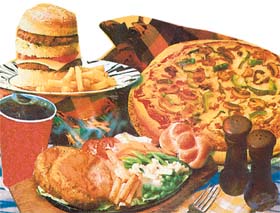
New advertising rules that will officially label cheese as "junk food" were condemned yesterday by the dairy industry as unfair, misleading and counter-productive. Under regulations coming into force this month, broadcasters will be banned from advertising cheese during children's television programmes or in shows with a large proportion of child viewers, such as The Simpsons and Hollyoaks. The ban is part of a government drive to crack down on junk food adverts on television, which is designed to reduce the exposure of children to foods high in fat, salt and sugar. It follows evidence that TV commercials have an indirect impact on children's eating behaviour and are contributing to the obesity epidemic.
However, the dairy industry says the rules, which are being introduced by the television regulator Ofcom, are a nonsense. Under the nutrient profiling model used to distinguish junk food from "healthy" food, cheese is officially labelled as more unhealthy than sugary cereals, cheeseburgers, double chocolate chip cake and full fat crisps. The industry points out that if breast milk were covered by the rules, it too would be classed as junk food.
Dan Rogerson, the Liberal Democrat MP for North Cornwall, who chairs the All-Party Parliamentary Group on Cheese, branded the model as "simplistic and counter-productive". He said: "How preposterous that Ofcom restrictions should be based on a model so flawed as to take cheese off the air, while diet cola, which has no nutritional value whatever, is left firmly on children's menus. It has to be perverse that while milk may be advertised, a wholesome product made from milk - cheese - cannot."
Ofcom published its draft conclusions on junk food adverts in November and is expected to release its final report within weeks. Its initial report went much further than expected. It proposed banning the advertising of all foods classified as high in fat, salt and sugar during programmes made for children under 16, on dedicated children's channels and during programmes with a higher than average proportion of child viewers. However, the ban only covered specific foods, not brands. So while McDonald's cannot advertise burgers during children's programmes, it could promote its restaurants.
The rules also proposed a ban on cartoon characters for adverts aimed at primary school age children shown at any time of the day. The most controversial part of the proposals is the use of the nutrient profiling model drawn up by the Food Standards Agency. The model assesses the fat, sugar and salt content in a 100g or 100ml serving of a food or drink - rather than a typical serving.
The food industry says the use of the FSA model has led to anomalies. Tomato ketchup, for instance, contains a high proportion of sugar and salt and is counted as a high fat, salt and sugar food - even though most people only eat a small amount with a meal. Marmite, which contains 11 per cent salt, is also counted as junk food - even though most people eat only a few grams on bread.
The British Cheese Board says the typical portion size of cheese is 30g to 40g, the size of a small matchbox, not the 100g used in the FSA nutrient profiling model. If a typical portion sized was used in the model, most cheese would be exempt from the ban, it says. Nigel White, a spokesman for the board, said: "Cheese is one of the most nutritionally complete foods and can play an important part of a healthy balanced diet for children of all ages."
Source
Foods caught by the junk food ban:
Marmite, Flora Lite, half-fat cheddar cheese, Dairylea triangles, bran flakes, camembert, sugar-coated puffed wheat, instant hot oat cereal, Jaffa cakes, reduced calorie mayonnaise, multi-grain hoop cereal, half-fat creme fraiche, takeaway chicken nuggets, potato waffles, Greek yoghurt (sheep), ham, sausages, bacon rashers, low-fat spreads, peanuts, cashew nuts, pistachio nuts, peanut butter, raisins, sultanas, currants, low-fat potato crisps, olive oil, butter, pizza, hamburgers, tomato ketchup, chocolate, brown sauce, cola, lemonade
Most lethal killer found

Scientists believe they have captured the most lethal creature on the planet in north Queensland. The tiny but deadly irukandji jellyfish is believed responsible for killing American tourist Robert King off Port Douglas five years ago.
In a piece of detective work worthy of Hercule Poirot, stinger expert Lisa-Ann Gershwin has spent years scouring north Queensland waters for the highly venomous and near-invisible culprit. Her breakthrough came on New Year's Day when the previously unknown, peanut-sized creature, trailing four tentacles, ghosted under her spotlight about 8pm off the jetty at Mission Beach. Comparing stinger cells taken from Mr King at Cairns Hospital in 2002 with the newly-discovered species, researchers found a perfect match.
"This is the killer," Dr Gershwin said. "We knew it existed but we have never before captured one live and healthy. These are a wicked, highly venomous, dangerous animal, that drop for drop are the most lethal on the planet."
The high-profile death of Mr King off Port Douglas in 2002 sent shockwaves through the state's multimillion-dollar tourism industry and led to a taskforce to investigate the little known irukandji. Irukandji syndrome, caused by other species of the tiny jellyfish, is known to cause excruciating back pain, sweating, and nausea, but until the 2002 incident, not death. "We know almost nothing about these animals," Dr Gershwin said. "But now, with this new specimen, we can start to find out more."
Source
Hot water best for jellyfish sting
Hot water is the most effective way to relieve the pain of a jellyfish sting, a study has found. Doctors and medical students at Busselton Hospital in Western Australia purposefully stung themselves with jellyfish to compare four popular treatments - ice, vinegar, aluminium sulfate and hot water. "Hot water was the only successful treatment, relieving 88 per cent of the pain," the team wrote in the latest Medical Journal of Australia. "Other treatments were incomplete and temporary."
They said that sting patients treated with hot water at about 45C got "significant" pain relief in 4-10 minutes, and the heat also appeared to stop inflammation. "There is an urgent need for knowledge of this simple remedy to be spread," said study author, Dr John Taylor. "And there is the potential that it could even be lifesaving when used with more serious jellyfish stings in the north of Australia."
Source
The original journal article is here. The treatment seems to work for a variety of jellyfish species and even other marine toxins
****************
Just some problems with the "Obesity" war:
1). It tries to impose behavior change on everybody -- when most of those targeted are not obese and hence have no reason to change their behaviour. It is a form of punishing the innocent and the guilty alike. (It is also typical of Leftist thinking: Scorning the individual and capable of dealing with large groups only).
2). The longevity research all leads to the conclusion that it is people of MIDDLING weight who live longest -- not slim people. So the "epidemic" of obesity is in fact largely an "epidemic" of living longer.
3). It is total calorie intake that makes you fat -- not where you get your calories. Policies that attack only the source of the calories (e.g. "junk food") without addressing total calorie intake are hence pissing into the wind. People involuntarily deprived of their preferred calorie intake from one source are highly likely to seek and find their calories elsewhere.
4). So-called junk food is perfectly nutritious. A big Mac meal comprises meat, bread, salad and potatoes -- which is a mainstream Western diet. If that is bad then we are all in big trouble.
5). Food warriors demonize salt and fat. But we need a daily salt intake to counter salt-loss through perspiration and the research shows that people on salt-restricted diets die SOONER. And Eskimos eat huge amounts of fat with no apparent ill-effects. And the average home-cooked roast dinner has LOTS of fat. Will we ban roast dinners?
6). The foods restricted are often no more calorific than those permitted -- such as milk and fruit-juice drinks.
7). Tendency to weight is mostly genetic and is therefore not readily susceptible to voluntary behaviour change.
8). And when are we going to ban cheese? Cheese is a concentrated calorie bomb and has lots of that wicked animal fat in it too. Wouldn't we all be better off without it? And what about butter? It is just about pure fat. Surely it should be treated as contraband in kids' lunchboxes! [/sarcasm].
Trans fats:
For one summary of the weak science behind the "trans-fat" hysteria, see here. Trans fats have only a temporary effect on blood chemistry and the evidence of lasting harm from them is dubious. By taking extreme groups in trans fats intake, some weak association with coronary heart disease has at times been shown in some sub-populations but extreme group studies are inherently at risk of confounding with other factors and are intrinsically of little interest to the average person.
The use of extreme quintiles (fifths) to examine effects is in fact so common as to be almost universal but suggests to the experienced observer that the differences between the mean scores of the experimental and control groups were not statistically significant -- thus making the article concerned little more than an exercise in deception
*********************
Tuesday, January 2, 2007
FAT POLITICS
"It began with Ethnic Studies, which, even if you don't approve of them, at least contain some fragments of actual history and sociology. Then our universities opened themselves to Women's Studies, closely followed by Queer Studies, then Disability Studies. If you think that has exhausted the possibilities for giving claims of victimhood their own college departments, professors, and budgets, you have underestimated the ingenuity and ambition of the grievance industry.
Get ready for Fat Studies. Yes: Fat activism, which goes back at least to the 1960s, has at last attained academic standing. The University of Wisconsin in Milwaukee is offering a course titled "The Social Construction of Obesity." There is no such thing as being fat, you see; "fatness" is just a figment. Nor is there any substance to claims by "scientists" that "obesity" is "linked" to diabetes, hypertension, or heart disease. Those are just ploys by the oppressive power structure to perpetuate discrimination against ...
Well, you get the idea. "Fat scholars" (sic-we are quoting here from the New York Times) "hope that one day fat studies will be as ubiquitous on campus as Shakespeare." It is at any rate a relief to know that the Bard-who had his own, mostly fond, opinions of fat people-has not yet been crowded out of the college curriculum by these faddy, bogus new "studies."
More here
US hospitals boost effort to kill resistant bugs
As infections that patients pick up in hospitals grow increasingly resistant to antibiotics, US facilities are turning to more aggressive measures. This includes a "search and destroy" approach borrowed from Europe.
Each year staph infections and other powerful bugs that thrive in hospitals kill 90,000 people and result in $US4.5 billion ($A5.8 billion) in excess costs, according to the US Centres for Disease Control and Prevention (CDC). A study published earlier this month in the American Journal of Medical Quality found hospitals lost $US27,000 ($A35,000) for each patient who gets a preventable infection there. Insurers reimburse many hospital stays by the diagnosis rather than per day, and payment drops off the longer patients stay in the hospital. "A lot of hospital administrators don't realise how expensive these infections are," said Lance Peterson, head of epidemiology at Evanston Northwestern Hospital, located outside Chicago. However, the costs have not escaped the notice of the government and private insurers that collectively fund most of the $US2 trillion ($A2.5 trillion) US health-care tab.
Antibiotic resistant strains, or "super bugs", now account for about two-thirds of infections associated with health care. Vancomycin is most often used to treat the stubborn infections, but some have become resistant to the antibiotic.
Betsy McCaughey, founder of the non-profit Committee to Reduce Infection Deaths, said most evidence showed that three steps could dramatically cut infection deaths in hospitals. But she said most US facilities were not implementing these practices - meticulous hand-washing between procedures, cleaning equipment between patient use, and identifying infected people before they enter the hospital. "About 90 per cent of patients treated in a hospital know well ahead of time they will be admitted, and can be tested in a doctor's office a week before," McCaughey said.
The CDC suggests that hospitals screen high-risk patients, such as those with weak immune systems, but does not recommend testing all patients for infection. That leaves hospitals to experiment with myriad approaches, resulting in a lack of consistency, experts said. In fact, big for-profit chains like Tenet Healthcare Corp and Triad Hospitals leave policies on handling infections up to local administrators.
Evanston Northwestern, affiliated with Northwestern University and part of a small local network, is one of a handful of US hospitals to implement "universal surveillance" - testing every patient that walks in the door for an infection. When it gets a positive result, it isolates the patient, gives him or her a powerful antibiotic, and requires all people going into the room to wear gowns and gloves. For every patient with an untreated infection, four or five start carrying it in their nose, Northwestern's Peterson said. The hospital's "search and destroy" approach steals a page from some European countries like the Netherlands, where hospital-acquired infections are rare.
A key component of Evanston's effort is Becton Dickinson & Co's new gene-based test, which gives results in a few hours, compared to a few days with an older product. About 160 of the 5,000 US hospitals use the test, up from 60 a few months ago. But some experts question whether the rapid gene-based test is more cost-effective than the older - and much cheaper - culture-based version that takes a few days to interpret.
Robert Weinstein, a doctor at Chicago's Cook County hospital and the recipient of a CDC grant to study the issue, said the new test needed peer-reviewed data to support widespread use. Tenet spokesman Steven Campanini said the company did not deem the test as essential. Each test costs about $US25 ($A33), and the equipment needed to run it costs about $US30,000 ($A40,000). If hospitals don't want to make that capital investment, there are leasing and other payment options.
McCaughey says the test is definitely preferred for emergency patients who can't be tested ahead of time, but does not make the old test obsolete for other patients. "It is easier to use," she said. "If you don't have a rapid test, you have to isolate the patient until the test comes back."
Meanwhile, public and private insurers are employing both a carrot and a stick to push hospitals to make changes. On a national level, the US government is considering halting payments for avoidable infections to patients on Medicare, the federal health insurance program for about 43 million elderly and disabled. Illinois, Pennsylvania and a handful of other states require reporting infection rates, and about two dozen others are considering a mandate. States fund health care through the Medicaid insurance program for the nation's 53 million needy.
In Illinois, private insurer Blue Cross Blue Shield is giving Evanston Northwestern a bonus payment of about 10 per cent for avoided infections. Many insurers are also "trying to ratchet down the payments" for the preventable infections, Peterson said. In Texas, about two dozen hospitals in the Blue Cross Blue Shield network agreed to use a software tracking system that seeks to identify the infections, made by Cardinal Health. The insurer shares the cost with each hospital, and the hospital must share the results with the insurer, said Rick Haddock, senior director of special programs of Blue Cross of Texas. "We're trying to find a better mousetrap," he said, adding that the effort has saved $US1.6 million ($A2 million) and prevented 326 infections over several years.
Source
Update:
The full name of the Evanston institution is "Evanston Northwestern Healthcare".
****************
Just some problems with the "Obesity" war:
1). It tries to impose behavior change on everybody -- when most of those targeted are not obese and hence have no reason to change their behaviour. It is a form of punishing the innocent and the guilty alike. (It is also typical of Leftist thinking: Scorning the individual and capable of dealing with large groups only).
2). The longevity research all leads to the conclusion that it is people of MIDDLING weight who live longest -- not slim people. So the "epidemic" of obesity is in fact largely an "epidemic" of living longer.
3). It is total calorie intake that makes you fat -- not where you get your calories. Policies that attack only the source of the calories (e.g. "junk food") without addressing total calorie intake are hence pissing into the wind. People involuntarily deprived of their preferred calorie intake from one source are highly likely to seek and find their calories elsewhere.
4). So-called junk food is perfectly nutritious. A big Mac meal comprises meat, bread, salad and potatoes -- which is a mainstream Western diet. If that is bad then we are all in big trouble.
5). Food warriors demonize salt and fat. But we need a daily salt intake to counter salt-loss through perspiration and the research shows that people on salt-restricted diets die SOONER. And Eskimos eat huge amounts of fat with no apparent ill-effects. And the average home-cooked roast dinner has LOTS of fat. Will we ban roast dinners?
6). The foods restricted are often no more calorific than those permitted -- such as milk and fruit-juice drinks.
7). Tendency to weight is mostly genetic and is therefore not readily susceptible to voluntary behaviour change.
8). And when are we going to ban cheese? Cheese is a concentrated calorie bomb and has lots of that wicked animal fat in it too. Wouldn't we all be better off without it? And what about butter? It is just about pure fat. Surely it should be treated as contraband in kids' lunchboxes! [/sarcasm].
Trans fats:
For one summary of the weak science behind the "trans-fat" hysteria, see here. Trans fats have only a temporary effect on blood chemistry and the evidence of lasting harm from them is dubious. By taking extreme groups in trans fats intake, some weak association with coronary heart disease has at times been shown in some sub-populations but extreme group studies are inherently at risk of confounding with other factors and are intrinsically of little interest to the average person.
The use of extreme quintiles (fifths) to examine effects is in fact so common as to be almost universal but suggests to the experienced observer that the differences between the mean scores of the experimental and control groups were not statistically significant -- thus making the article concerned little more than an exercise in deception
*********************
Monday, January 1, 2007
PROGRESS IN TREATING DIABETES AND ITS EFFECTS
Notes from a diabetic
The first breakthrough, one I didn't predict, is a drug, called Metanx (pronounced, stupidly enough, "MET-an-ex" when it obviously should be "met-TANKS"). My doctor tells me it's acquiring a reputation for reversing diabetic neuropathy, something I'd thought impossible. Let me assure you it ain't. I have some hope it might even deal with a special kind of neuropathy, retinopathy, which is what you call it when diabetics slowly go blind.
The breakthrough I did predict, I called the "Bassett coil", after the doctor who invented it. I read about it in 1977 in the National Inquirer, believe it or not. Despite the source, the story seemed credible, so when a badly shot-up Win Bear, hero of The Probability Broach, wakes up in Ed Bear's home, being treated by Healer Clarissa MacDougall Olson, he has these "Bassett coils" fastened all over his body....
The idea behind the coils, as I understood it way back then, is that electromagnetic fields can be used to encourage and control calcium ion deposition in the human body. Bassett's invention was seen as a way to help old people with broken bones heal faster-when they weren't healing at all without this treatment. I had a good family friend who had to have her femur surgically removed because it wasn't healing and finally infected, so I understood very well what's at stake. It turned out that the primary use to which this progress was put was in the rapid healing of professional sports injuries-nothing to sneer at, since professional sports ends up financing a lot of medical progress....
The bone stimulator is ultrasonic, rather than electronic, and one thing it accomplishes is to increase circulation drastically, it says here, while stimulating various complex features on the membranes of individual cells. It's a little black plastic disc held in place with a Velcro strap, and there's a lead to a small box about the size of an overly thick PDA. The only sensation I can associate with it is of an increased warmth, although any pain I was feeling is now gone, along with a sense of strain and distention that was bothersome and sort of ominous....
Although it's difficult to imagine anything much spiffier coming to pass than the bone stimulator, the really big news this holiday season-a Christmas present of inestimable proportion, from Canadian science to all sixteen million of us-is that diabetes has been cured. Completely. Irrevocably. In mice.
This has to do with a previously unknown effect that pain neurons have in the Islets of Langerhans. No, these are not Danish coastal features, but the parts of the pancreas that produce insulin, the lack of which constitutes Type I diabetes. It seems these naughty neurons secrete an enzyme, or cause it to be secreted, that shut the islets off. But the neurons can be shut off, themselves, by judicious use of capsaicum, the stuff that makes chilis hot. Some other enzyme is then administered to the pancreas that turns the islets back on, and the diabetic organism-as I said, only mice, so far-are through with Glucophage, glypizide, blood tests, insulin injections, and can eat all the buttery mashed potatos, Mexican food, and chocolate cake they want. Merry Chistmas, mice!
What's more, for reasons that are so far completely unknown, the capsaicum treatment appears to work on Type II diabetes-which in many ways has always seemed like a completely different disease-as well. How soon this will get to people, I can't say. Not soon enough. If I weren't diabetic, I could look forward to living another 30 or 40 years without pain, and in tolerable good health-long enough to die of cancer, anyway. If the government-induced delay extends the process by even a microsecond, then it's time to abolish the FDA once and for all.
Source
British ad ban takes big bite out of Burger King
Burger King, the world's second largest fast-food chain, estimates that the ban on children's advertising could cost it up to 100 million pounds in lost UK sales next year. The prediction came as the company's new management in the UK vowed to fight regulatory interference and a declining fast-food market. Giorgio Minardi, the company's head of north west Europe, in his first UK interview, said: "Advertising is a key part of our drive to get kids and families into our restaurants. It will have a major impact on our top line."
His comments come less than a week after Burger King aired its last advert aimed at children - an advert promoting penguin toys based on the hit animated film Happy Feet.
Mr Minardi, a former senior McDonald's executive, joined its arch rival earlier this year and is leading an almost entirely new team in the UK, vowing to turn around the struggling fast-food chain. "There is life yet in the burger," he said. Like McDonald's, Burger King has suffered from the relentless competition on the high street and the change in consumers' habits. One of his first decisions was to end adverts aimed at children, before regulators enforced any ban, outmanoeuvring many of his competitors.
He and his new head of marketing David Kisilevsky, have also, controversially, heavily promoted its calorific Double Whopper burgers. Mr Kisilevsky said: "People are starting to get a little bit fed up with the nanny state intrusion in our lives. It was important for Burger King to come out in a light-hearted way and say there is nothing wrong to partake in your love of a great burger."
Burger King spends about 10m a year on advertising, with traditionally a third of that geared towards children. Mr Minardi said that once the children's adverts stop airing the turnover will be hit "without doubt by approximately 10 to 15pc."
The company, which is listed on the New York Stock Exchange, does not split out sales from individual countries but market research firm Euromonitor estimates that Burger King in the UK generated sales of 693m in 2004. Though sales are forecast to have fallen since then, the impact on sales could therefore be 100m in a worst-case scenario. This is a far higher figure than most in the industry are prepared to predict. Ofcom estimates that the lost advertising revenue to broadcasters will be 39m when the ban comes into force next year. However, the regulator never calculated the possible lost revenue to the UK fast-food industry, reckoned to be worth 13bn in annual sales.
Mr Kisilevsky said he was confident the hit could be partly offset: "We are redeploying some of our advertising spend to focus that on to families." Mr Minardi confirmed that the company would continue to sell toys in its restaurants. "There's nothing wrong with our kids meals, and the toys are part of that experience. We're not going to take them out. What we're not going to do is target kids directly." He added that, after years of decline, sales in the UK were now in positive territory thanks to the launch of the Aberdeen Angus beef burger, which has been a hit with its diners
Source
****************
Just some problems with the "Obesity" war:
1). It tries to impose behavior change on everybody -- when most of those targeted are not obese and hence have no reason to change their behaviour. It is a form of punishing the innocent and the guilty alike. (It is also typical of Leftist thinking: Scorning the individual and capable of dealing with large groups only).
2). The longevity research all leads to the conclusion that it is people of MIDDLING weight who live longest -- not slim people. So the "epidemic" of obesity is in fact largely an "epidemic" of living longer.
3). It is total calorie intake that makes you fat -- not where you get your calories. Policies that attack only the source of the calories (e.g. "junk food") without addressing total calorie intake are hence pissing into the wind. People involuntarily deprived of their preferred calorie intake from one source are highly likely to seek and find their calories elsewhere.
4). So-called junk food is perfectly nutritious. A big Mac meal comprises meat, bread, salad and potatoes -- which is a mainstream Western diet. If that is bad then we are all in big trouble.
5). Food warriors demonize salt and fat. But we need a daily salt intake to counter salt-loss through perspiration and the research shows that people on salt-restricted diets die SOONER. And Eskimos eat huge amounts of fat with no apparent ill-effects. And the average home-cooked roast dinner has LOTS of fat. Will we ban roast dinners?
6). The foods restricted are often no more calorific than those permitted -- such as milk and fruit-juice drinks.
7). Tendency to weight is mostly genetic and is therefore not readily susceptible to voluntary behaviour change.
8). And when are we going to ban cheese? Cheese is a concentrated calorie bomb and has lots of that wicked animal fat in it too. Wouldn't we all be better off without it? And what about butter? It is just about pure fat. Surely it should be treated as contraband in kids' lunchboxes! [/sarcasm].
Trans fats:
For one summary of the weak science behind the "trans-fat" hysteria, see here. Trans fats have only a temporary effect on blood chemistry and the evidence of lasting harm from them is dubious. By taking extreme groups in trans fats intake, some weak association with coronary heart disease has at times been shown in some sub-populations but extreme group studies are inherently at risk of confounding with other factors and are intrinsically of little interest to the average person.
The use of extreme quintiles (fifths) to examine effects is in fact so common as to be almost universal but suggests to the experienced observer that the differences between the mean scores of the experimental and control groups were not statistically significant -- thus making the article concerned little more than an exercise in deception
*********************
Subscribe to:
Posts (Atom)